If you have ever looked at a medieval painting of the Virgin Mary holding the baby Jesus and thought, Why does that baby look like a 47-year-old man?, you are not alone.
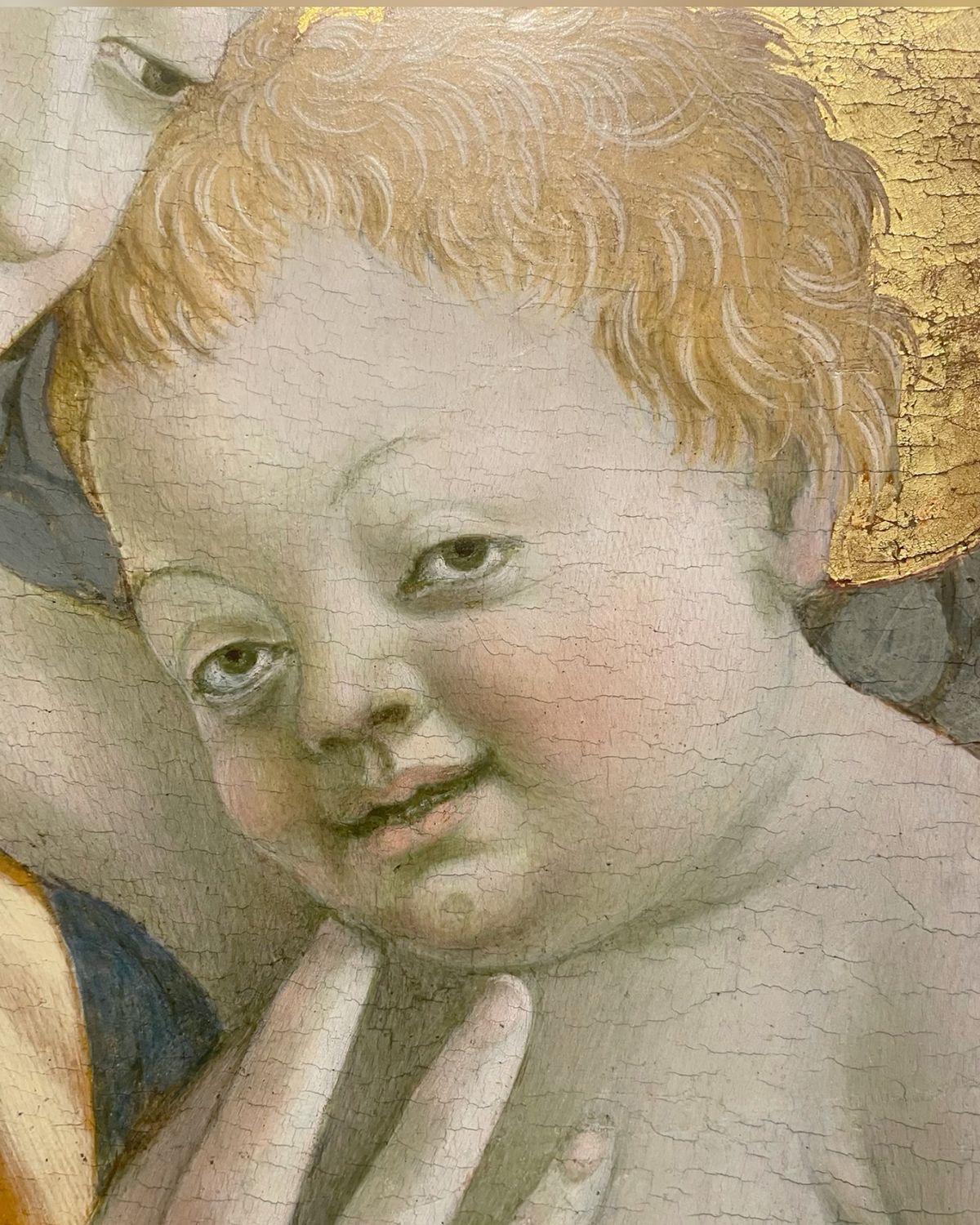
Medieval babies have a very specific look. They are often bald, strangely muscular, intensely serious, and sometimes seem to have the faint five o’clock shadow of someone who has been paying taxes for several decades.
Their proportions can be especially strange: tiny bodies, enormous adult heads, and faces that look less like they belong to a newborn and more like they belong to a miniature professor.
And, unfortunately for medieval babies everywhere, Jesus is partly to blame.
One word helps explain this bizarre phenomenon: homunculus.
A homunculus, Latin for “little human,” is an artistic idea in which a figure is represented as a miniature, fully formed human rather than as a realistically developing child. In images of the Virgin and Child, this could mean that Jesus was shown with the body of a baby but the physical and intellectual appearance of an adult. He could often have the posture, proportions, expression, or facial features of a grown man squeezed into an infant’s body.
This artistic choice might seem strange. Why not just paint a baby?
Because Jesus was not understood as just a baby.
For medieval Christian artists and viewers, the infant Jesus was simultaneously human and divine. He may have entered the world as a newborn, but he was also believed to be God.
Depicting him as an ordinary, helpless infant could therefore create an uncomfortable problem: how do you visually communicate that this tiny person is also the eternal Christ?
The solution was, essentially, to give Baby Jesus a tiny business suit made of skin.

The homunculus-like Christ looks strange to modern viewers because we expect artists to make babies look like babies, but medieval religious art was not always primarily concerned with anatomical realism. Images could communicate ideas through symbolism, hierarchy, gesture, scale, and appearance.
In other words, the point was not necessarily, “This is exactly what Jesus looked like when he was three months old.” The point could be, “This is the infant Christ, and remember, he is already divine.”
As a result, the baby Jesus shown in some medieval paintings looks less like someone who should be feeding on milk and more like someone who should be cracking open a cold bottle of it.
And this is where things get interesting. The homunculus did not exactly stay in Jesus’s crib; these depictions influenced other images of children.
Imagine you’re a wealthy medieval parent. You have money, connections, and enough social standing to commission an artist to paint your beloved newborn. Your baby is perfect: he has soft little cheeks, tiny hands, the general appearance of a warm dinner roll. You hand the artist your baby. Several months later, you receive the portrait.
You stare at it. Your baby’s forehead is the size of a cathedral. His hands look like they have signed several legal documents. He has the facial expression of a man who has just discovered that he has been summoned for jury duty. And somehow, his hairline has already begun retreating.
You look at the painting.
You look at your baby.
You look back at the painting.
And you decide to pay the artist extra, for in a European culture saturated with Christian imagery, what could possibly be more flattering than having your child look similar to Christ?
As we know, Jesus was not understood as an ordinary baby; the Christ Child became a powerful visual model for what a child of significance could look like.
So, when we encounter children in medieval art who seem strangely mature, the answer is not necessarily that medieval people had forgotten what children looked like.
Rather, the depiction was about what the artist needed the baby to communicate.
A child in an image might represent innocence, lineage, inheritance, devotion, family continuity, or social status. A child could be important not because of their individual personality, but because of what their existence meant for the family, the church, or the story being depicted.
Sometimes, depicting this representation meant making the child look holy. Sometimes, it meant making them look important. Sometimes, it meant giving them the face of a man who appears to have opinions about municipal zoning laws. Realism was not always the highest priority.
Thus, it would also be misleading to say that medieval artists simply “couldn’t draw babies.” They could draw all kinds of things with remarkable skill, including extraordinary observations of animals, plants, clothing, architecture, gestures, and human bodies.
The strange baby was not necessarily evidence of artistic incompetence, but potential evidence that the artist was following a meaning-over-resemblance visual language.
However, the rules of medieval art began to change near the end of the fifteenth century. As European artists became increasingly interested in naturalism, observation, and the physical behavior of the human body, babies started looking considerably more like babies.
They got softer, rounder, and squishier. They started reaching for things and wriggling around instead of sitting upright like tiny theologians.
This change did something more important than simply making medieval babies less horrifying.
It made Christ’s humanity easier to see.
Mary could look less like an icon holding a theological concept and more like an actual mother holding her child. She could touch him, look at him, feed him, and respond to him. Images of the Virgin breastfeeding, for example, emphasized Christ’s physical humanity and vulnerability.

The theology was still there, but now, the baby actually looked like a baby.
Perhaps the funniest thing about the entire medieval baby problem is that we look at these paintings and think the artist has made a mistake, but they may have been doing exactly what the image required.
We see a bald, wrinkled homunculus and ask, “Why doesn’t this look like a baby?”
The medieval viewer could look at the same image and ask, “Why would it need to?”
Because the point was never necessarily to show us what a baby looked like.
The point was to show us who the baby was.
And if that meant giving them the face of a 47-year-old man who had somehow been compressed into a onesie, well, at least they looked holy.
To contact this writer, email Muse Newspaper at musebsa@bsfa.org.