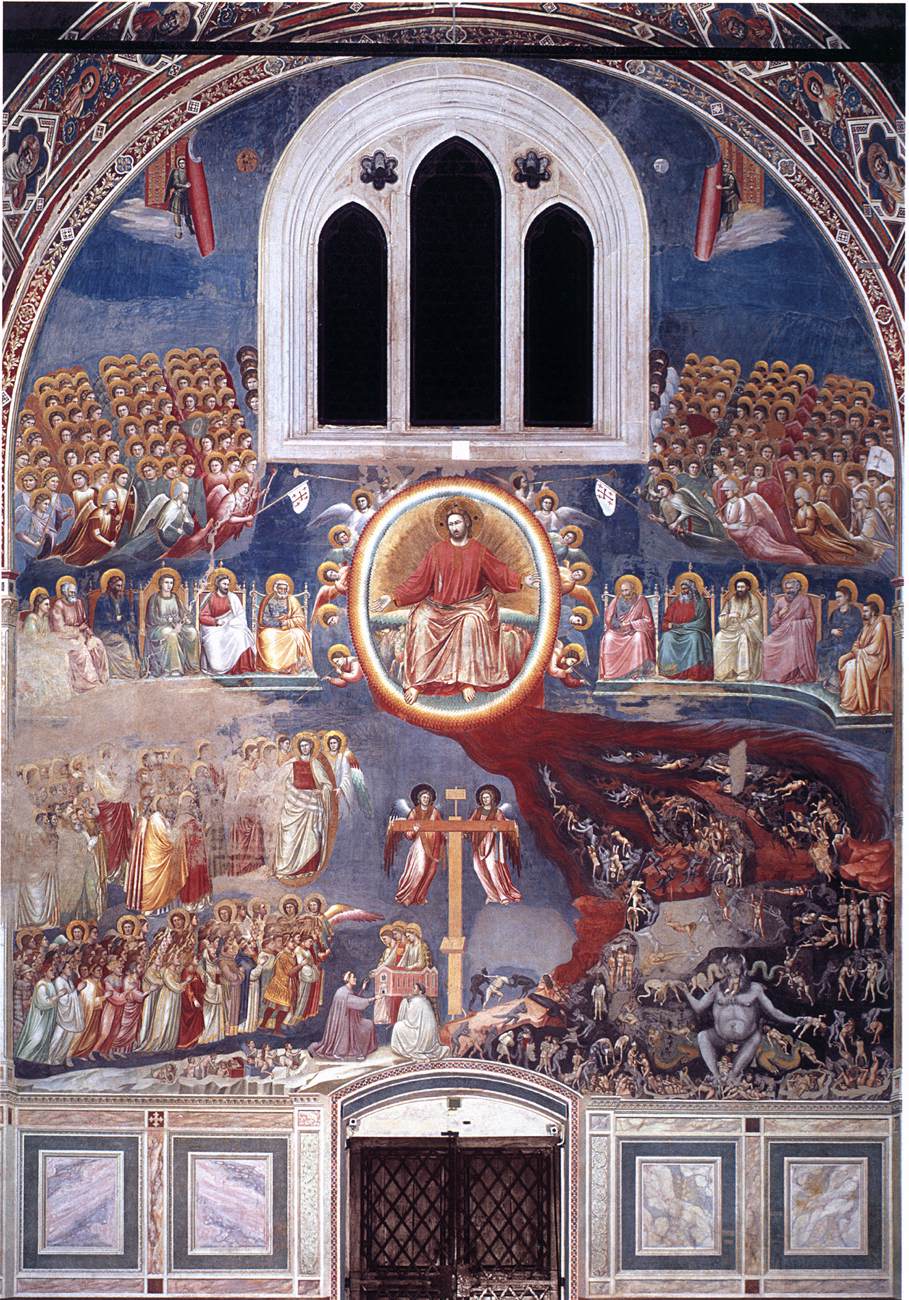
Around the year 1306, Giotto di Bondone painted The Last Judgement on the walls of the Scrovegni Chapel in Italy. Giotto utilized the buon fresco technique, a practice in which the artist paints with water-based pigments directly on top of wet lime plaster so that the pigment is permanently bound into the wall as the plaster cures. The scene depicts the Biblical Second Coming of Christ, where humans are sent to either eternal bliss or damnation.
The counsel seated along the middle of the wall judges humanity on their actions and faith, influencing which fate they decide the people’s souls are worthy of. This scene is painted directly around the chapel’s doorway. Giotto meticulously places the devil depiction right over the exit, as if to watch churchgoers with threatening and cautionary eyes as they leave.
At first, the composition appears vertically split directly down the middle, but the Christ figure remains placed in the center. He is equidistant from the top, bottom, left, and right edges of the piece and is seated inside a gold mandorla, which is surrounded by small angels. Inside the mandorla, the Christ figure is depicted with a gold halo around his head and clothed in a light red cloak.
Christ’s arms are reached out to either side of his body, and his hands point to the two directions of heaven and hell. His left hand is faced palm downward, ushering our eyes to the bottom left corner, in which a chaotic, dark, and slightly blue scene of hell is depicted. His right hand is positioned palm upwards, motioning towards a glowing, simple group of blissful souls on their way to heaven.
The depiction of hell on the bottom left corner is evidently the most detailed section of this painting. A fiery red burst of flames stems from Christ’s mandorla and spreads out into three openings which lead into the dark underworld.

We can observe blue demon-like figures in the fire seemingly dragging souls down into the fiery pits. The demons further down are seen performing various methods of torture, separated into three sections. On the leftmost sector, figures are hung from branches by various parts of their bodies. The humans in the middle section are dragged into what appears to be a giant ball of interwoven and connected human bodies forced together in various manners. In the rightmost tunnel, human figures are dragged down and hung from trees and moneybags.
In the middle of the surrounding torture sits a large blue depiction of Satan. His figure is seen tightly clutching, ingesting, and later defecating humans whole. Behind Satan appears to be a dragon-like creature, holding and torturing the individuals, as well.
On the opposite side is the contrasting representation of the selected individuals who are grouped together as they rise to heaven. They are clothed in pastel cloaks of different colors and appear to be in positions of prayer as their feet are lifted off the ground.

The appearance of the souls in this group communicates a great hopefulness, as they are cloaked in bright, joyous colors and seen with excited yet relaxed expressions. Accompanying the group are graceful angels spread out evenly throughout the crowd. The angels are each painted with a similarly kind and generous expression, with golden halos around their heads as they shepherd the group into heaven.
Directly below the heaven-bound group appears to be nude children crawling out of coffins. Some scholars have interpreted these children as representing the souls of those awaiting judgment from Christ. The children are crawling out of coffins because the souls are being actively resurrected. During this period of Proto-Renaissance art, children are often shown in artistic works to represent humans’ most innocent and pure form, hence, the representation of souls as children. This choice seems to emphasize the purity and sinlessness of the soul in its simplest, most original form.
Enrico Scrovegni, the patron who commissioned the fresco from Giotto, is depicted next to the resurrected children, kneeling and repenting for his sins. His addition to this portrait is no coincidence on Giotto’s part. Scrovegni’s father built his family’s fortune off of fraud and white collar crime, actions so extreme that he inspired a section of Dante’s Inferno. To save his father (and himself) from damnation, Enrico donated a great deal of money to the chapel in hopes of a more favorable afterlife.
Because of this history, it can be inferred that Giotto’s depiction of Enrico intentionally draws attention to the irony of his attempt to be relieved of his family’s sins. The idea that using money and privilege is a potential loophole to be forgiven by Christ for sinful actions almost seems sacrilegious. Giotto especially highlights this irony in his depiction of hell, where one torture method involves people being hung from money bags. This may symbolize Enrico’s attempt to “be lifted” to heaven through means of his wealth, and how it, ironically, is a form of torture in hell instead.
Giotto also infuses meaning into the torture methods depicted. In the Bible, different methods of torture exist for different sins committed during the souls’ time on earth. For example, usury—charging extortionately high interest rates on loans—has been historically considered a sin. In Giotto’s depiction of damned souls, those who committed usury are seen hanging from money bags. Another individual being hanged below the usurers is Judas, the disciple that betrayed Christ by identifying him to the armed soldiers who arrested him.
Finally, the placement of this piece is a deliberate choice. The Last Judgment is a monumental occurrence in the Bible, one that leaves Christians prepared for what the afterlife might look like. Giotto placed the painting around the door that exits the chapel, making the piece the last thing that people see before they leave. This choice imprints a message on individuals as they leave the church and enter back into the mortal world of temptation and greed. The painting reminds people where they might ultimately arrive, depending on the choices they make during their time on earth.
To contact this writer, email Muse Newspaper at musebsa@bsfa.org.