Fra Angelico, devoting his life to the church, was a friar in the Dominican Order in Florence, Italy, during the fifteenth century. He was also an artist of the early Italian Renaissance, creating works in deep devotion to his craft and spirituality.
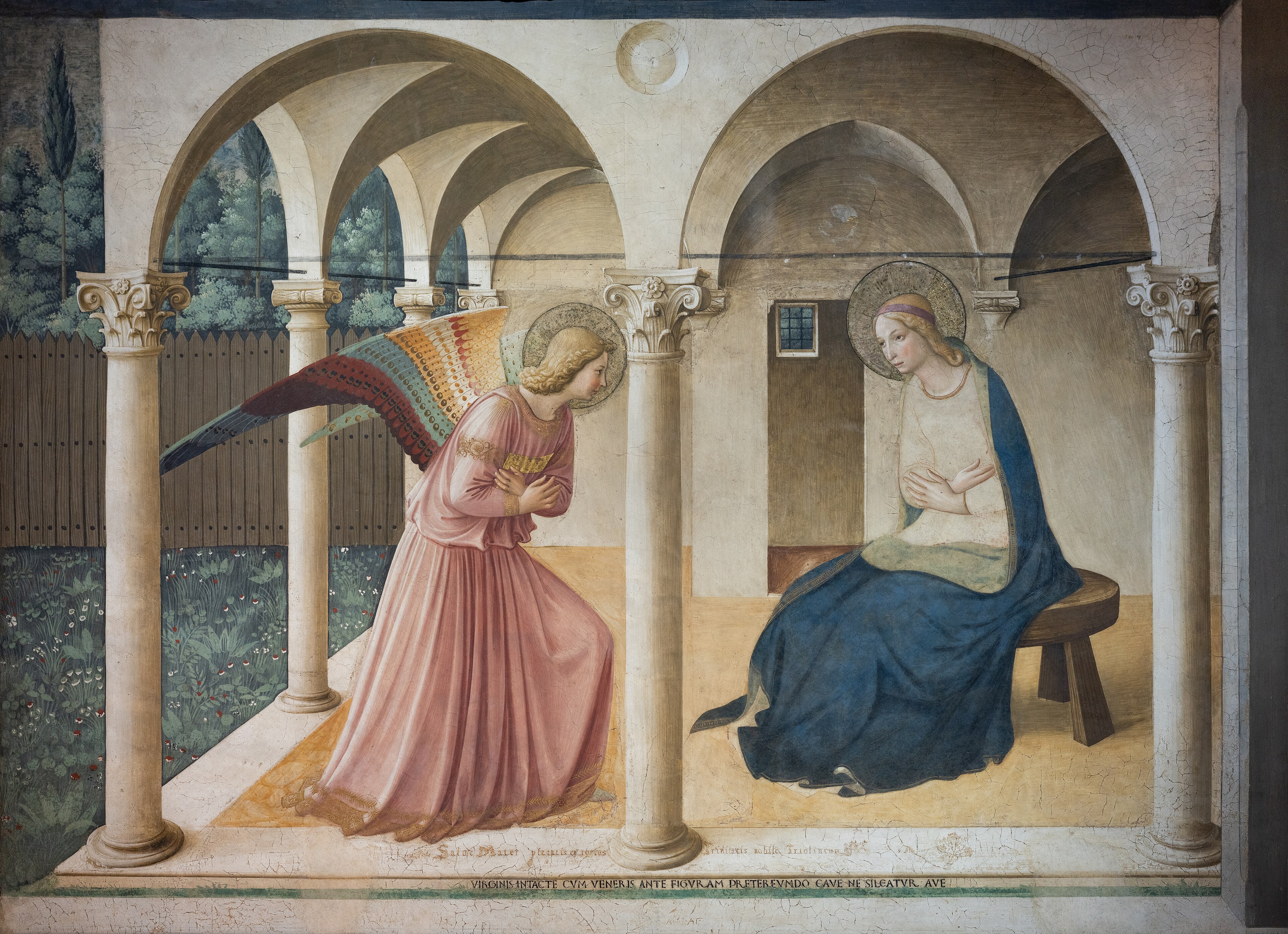
In 1436, at the convent of San Marco in Florence, Italy, Angelico’s large buon fresco masterpiece “The Annunciation” was painted. The fresco depicts the story of the Annunciation, in which the angel Gabriel gives the news to Mary that she is chosen to carry Christ.
The fresco wasn’t meant to depict historical accuracy within the architecture or spatial setting of the story from the ancient texts, but rather a monastic/ecclesiastic setting resembling the modern monastery it was painted in. The modern architectural conventions in favor offer a familiar place to the monks, rather than a biblically accurate setting, to evoke a familiarity in connection to the story for the monks. The setting invites the monks to consider their own inhabited space holy, and for them to be able to put themselves into the story of the Annunciation.
The fresco sits at the top of a stairwell in the convent. Rather than hanging high like a framed painting, the work is embedded into the architecture, becoming an extension of the wall itself. It functions not just as a buon fresco, where pigment is painted onto wet plaster, but also as an active extension of the physical space at the top of the stairs.
The artwork is not merely a picture to look at—instead, it extends the environment that the monks know and inhabit. By seemingly blending into the architecture, it bridges the monks’ daily environment with the holy scene, directly inviting them into the narrative and prompting deep spiritual reflection.
The fresco itself is not cluttered and rather blunt, with no distractions from the story. It is simple and doesn’t depict many indicators of what is happening around the figures of the story, because it doesn’t need to. Due to widespread illiteracy at the time, many religious artworks that decorated holy spaces were meant to teach viewers the Biblical stories, as they would not be able to read them for themselves. However, Angelico’s fresco was created for the eyes of the monks, who already knew the holy texts well. The fresco did not serve didactic functions in the convent because the monks did not need it to. “The Annunciation” was simply a reminder and an inviting space for the monks. With empty space and nothing flashy to distract the monks from the story, the fresco acts as a gateway to the holy story and invites the monks to interpret and connect with the story.
The fresco depicts two figures: the angel Gabriel facing the Virgin Mary, all surrounded in an outdoor monastery cloister, similar to the ones of the convent of San Marco.
On the viewer’s rightmost, we see the figure we can identify as the Virgin Mary, holding her hands to her chest and sitting upon a simple wooden stool, rendered in a white underdress and blue mantle with golden detail around the hem. She is shown with golden locks of hair held by a red headband, and behind her head, a halo that departs from the Renaissance’s celebration of naturalism and Humanism, and is rather aligned with a rendering of the holy nimbus in favor of artistic conventions of the Byzantine era, taking aesthetic conventions that are analogous to artists like Giotto. In the fresco, Angelico reverts back to an orb of light that follows the holy figure, rather than a physical form taking up space like in Masaccio’s “The Tribute Money” 10 years prior—painted and acknowledged as the new standard of rendering.
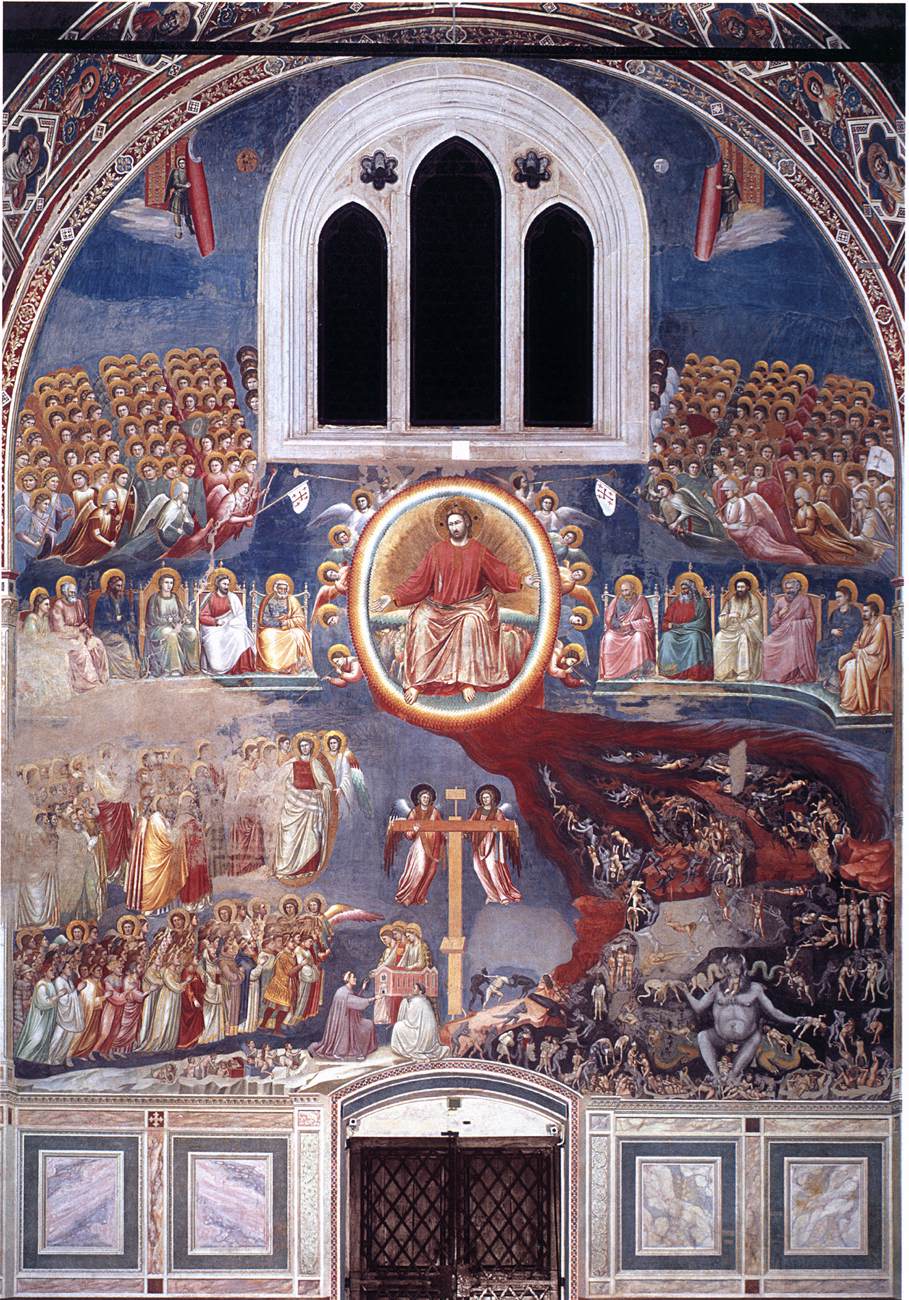
Angelico’s artistic conventions align strongly with those of Giotto di Bondone. Known mononymously as Giotto, the Italian painter from Florence during the Late Middle Ages is infamous for breaking away from traditional Byzantine aesthetic conventions in favor of a more human, realistic one.
A comparable difference between the two artists is found in the body language of the figures. In Angelico’s work, the figure of the Virgin Mary is depicted not consumed in fear, but more obedient, accepting the path forced upon her. On the contrary, in Giotto’s 1305 fresco depiction of the Immaculate Conception—at the Scrovegni Chapel—she is holding herself in fear. She is a young girl with scary news forced upon her, and she is depicted as such.
Giotto’s buon fresco is a part of the walls of the Scrovegni Chapel of Padua, Italy and his depiction of the Annunciation was needed to serve in a didactic function.
To keep the congregation of the Scrovegni Chapel engaged in the story, Giotto uses imagery to connect the audience to the story, just as Angelico does in his rendition for the monks of San Marco.
Giotto uses non-biblically accurate architecture, in favor of the modern architecture of 14th-century Italy, to connect the viewers to space within the story. Angelico uses the familiar monastery cloister to do the same for his audience.
Giotto used modern clothing to connect the congregation to the idea that Mary was only a girl and wore clothing that could be familiar to those attending. The clothes are what their daughters could be in, connecting those realizations to the aspect of Mary being just like them, an ordinary girl. Angelico uses a very simple stool for Mary to sit on, one that would have been familiar to the monks, as the style followed their ascetic values. Although there are so many similarities, the frescoes serve different purposes for the audiences, attributed to the body language of the figures differing.
The second figure of Angelico’s fresco is the angel Gabriel, bowing in front of Mary in a red, flowy, floor-length robe with gold detailing on the hems, clutching their hands to their chest, mirroring Mary’s own, and wrapping their arms around themself. The angel has golden locks of hair that are shoulder-length and has an idealized, ambiguous face that mimics that of Mary. Mary and Gabriel are similar in depiction, with Byzantine-like halos, though Gabriel’s halo is slightly smaller than Mary’s.
The angel has multicolored wings. Although Gabriel is often depicted with multicolored wings like these, in Renaissance art, it is important to highlight the unique genius hidden in the color order. The wings almost align and mimic the painting’s own color gradient, going from tan/gold and white to blue, leading to red, and ending with more blues and natural greens. The gold and tan are akin to the monastery walls; the white, gold, and blue are reminiscent of Mary’s clothing. The red of the wings is like the angel’s own robes, and the blues and greens remind the viewer of the nature on the painting’s left.
The nearly two-dimensional rendering of a forest, picket fence, and meadow emphasizes flatness. The painting’s right has elements of linear perspective (a technique used to create the illusion of three-dimensional depth and space), but this attention to depth seems to be lost on the left. This difference in rendering may be attributed to the separation of the earthly world—the forest and plants from the celestial realm and the monastery occupied by two holy figures.
However, we may also attribute this flatness to something more. The vanishing point—where all the horizon lines and all parallel lines that go into the distance appear to meet and disappear—and the steepness of the ground in the cloister seem to lack atmospheric perspective when looking at the fresco isolated as a painting only. But when you look at the fresco in the intended spatial context—viewing the fresco while ascending the stairs—it does not look flat, but rather just as an extension of the space. The fresco offers an extension from the stairs, prolonged to the hallway, and into the space inside the painting.

For the monks, seeing familiar architecture (the cloister) and indicators of the monks’ ascetic lifestyle (the stool that Mary sits upon) would heighten feelings of connection to the space they recognize as their own; they have probably sat in the same spot as the figures depicted.
However, when looking at the figures depicted, the viewer can identify that these figures are much too large for the space. If Mary stood up, she would probably hit her head. This is where we clearly see the hierarchical space that Gabriel and Mary take up.
Traditionally, hierarchical scale is used to highlight power differences between figures by literally making one larger than another. But Angelico utilizes convention to make the figures appear larger than the observing monks: they see that these figures are greater than them, as they take up more space in a familiar place. Hierarchical scale becomes the size difference between the figures of the painting and the viewer themself.
Devoted to craft and spirituality, by using modern and familiar settings and playing with perspective and scale, Fra Angelico transforms and transports the viewer from physical space to space within the fresco, bridging together the holy story and the viewer.
To contact this writer, email Muse Newspaper at musebsa@bsfa.org.