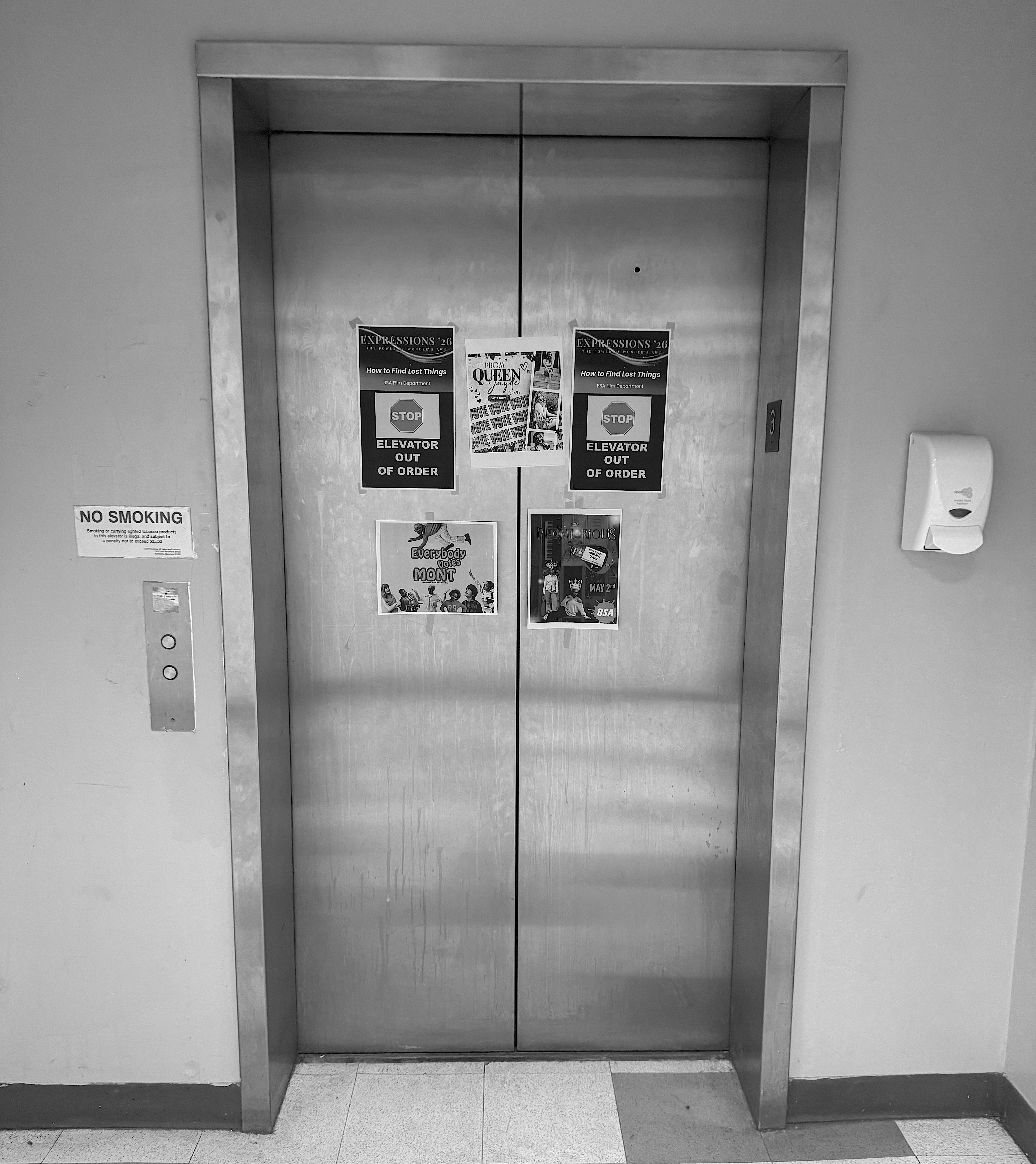
Every year, the Baltimore School for the Arts (BSA) Foundation sets a goal to raise $2 million to upkeep the school’s expensive necessities–film equipment, costuming, paid guests, a multitude of arts and academic teachers, art supplies , and countless other nuts and bolts to keep the gears of the school turning. But this income isn’t enough to cover one of the pressing student issues: facilities, specifically the bathrooms and elevators.
You may have heard general statements such as “the elevators are full again” or “the bathrooms are bad today” making their way through corners of the student body, and found yourself wondering: what’s wrong?
Elevators

For starters, BSA is an 8-story building that uses every floor for classes and offices. There are two elevators that run up and down the school throughout the day. In March of 2024, both elevators broke for two months, causing an uproar among staff and students.
“I have Pulmonary Hypertension- it’s a lung disease,” stated junior actor Stella Rodriguez. “When both elevators were out of order, that was a nightmare for me because I get really exhausted when I walk up even one flight of stairs.”
After fixing both elevators, BSA’s administration made the decision to return to their pre-COVID system of cutting down student access from two elevators to one, designating the other elevator to staff, students with physical disabilities, and students with injuries.
Ever since the repair of the elevators and the return of this policy, students have had mixed feelings on using them. On September 28, a form with multiple randomized polls regarding the necessity of elevators was released via social media and taken by 28 students attending BSA.
There are more reasons to take the crowded elevators than just to avoid a journey on the stairs. Students from different departments often have equipment to take between floors: film gear, paintings, props, etc. The form revealed that 81.5 percent of students surveyed use the elevators when carrying large/heavy arts equipment.
One of these students was sophomore visual artist J Gohl. Their experience carrying their art on the elevators is not all rainbows and butterflies.
“One time I was taking the elevator down from the seventh floor with a piece from my jury, and when we got to the third floor people pushed on and completely messed the piece up,” Gohl recalled.
In a separate poll, 46.4 percent of students admitted to using the “staff” elevator, submitting anonymous responses about how carrying equipment up the stairs is “dangerous” and “laborious”.
One of said students is junior visual artist Maya Hughes, who takes the elevator from her basement lunch to her seventh floor visual arts classes. “Sometimes there’s too many people in [the student elevator] so I sneak in the staff elevator, or else I have to walk,” Hughes said.
Some students are unaffected by the state of the elevators. Take, for instance, senior cellist Mallory Lerch. “I don’t take the elevators at all because everything’s on the second floor. That’s like a homebase,” said Lerch.
From seeing their past malfunctions, some students even distrust these particular elevators. “I feel like every time you fix it after it breaks, it gets a little bit worse each time. I think we’re all just waiting for it to break badly,” said junior stage design student Evan Applefeld.
Sophomore clarinetist Esther Robfogel is one of many students upset by the crowding in the elevators. “I don’t like when people use the elevators to go up a couple floors. It’s not that hard to walk up the stairs. I completely understand if someone has some physical issue, but that’s the whole point of the elevators; not just for lazy people,” Robfogel remarked.
So the discussion on elevators is consistent: limited access, past breakdowns, extreme crowding.
Bathrooms

These two elevators, however, are not the only facilities in discussion.
“We don’t have a door in the fourth floor bathroom anymore,” said junior actor Myia Lucas, referring to how one one of the stall doors has been missing since the beginning of the school year.
Lucas’s classmate, October Redman, expressed concern with using the bathrooms to change in and out of their all-black acting attire: “I used to change in the basement bathrooms but ever since the toilets started leaking, there’s always a puddle on the floor. It’s disgusting, and there’s so many people in every single stall.”
“One time, a visitor came in when I was changing and she tried to use the [lobby] bathroom and was struggling with the doors. She eventually just gave up and just walked back out,” added their classmate Julia Tollini, concerned about impressions visitors may have of the school.
The stall door Tollini is referring to is in the bathroom of the main lobby, which had a broken lock from April up until October 2024. Classmates had to hold it closed for each other to stop it from swinging open. The door now has a secondary lock.
There is, however, a separate set of well-kept bathrooms (four stalls each) in the lobby of the ballroom, both of which are locked from students during school hours and only opened for performances. This also sparks confusion among students: why should the nicely-kept bathrooms stay locked during school hours?
“I feel like if they’re going to close the ballroom bathrooms, they should make improvements on the ones they’re keeping open,” commented junior dancer Jenna Bates. “I think there’s a lot of issues with the dance bathroom especially: there’s always a clogged toilet in there, which is super inconvenient because it’s a really small bathroom.”
The women’s bathrooms are not the only ones under fire.
“The lock on the big stall on the second floor boys bathroom is broken- I literally have to tie it to stay closed,” said senior vocalist Elliot Bullock.
Senior percussionist Sam Wylie added, “There are literal holes in the wall. I went in this morning- there were five. This isn’t the first time I’ve had experiences like this: you know, sink doesn’t work, centipede crawls out. That’s happened to me twice.”
Others, however, commented that the bathrooms aren’t always a negative experience.
“It smells really nice [in the bathrooms] and I do not know why. It might be that janitor- I respect him for that,” said junior stage design student Ethan Rosenberg, likely referring to custodial worker Robert Neville who is often seen tidying the school after hours. Despite their contempt towards the technical facilities, students are often happy and grateful towards the custodial staff for the cleanliness of their shared spaces.
Rosenberg’s opinions are shared by many: content with hygiene, but annoyed by the facilities’ lack of technical upgrades, as well as decreasing efficiency through the school’s long and faced-paced schedule.
Solutions
The answer to these issues is much simpler than you’d expect.
Thomas Askey, the assistant principal of the school, explained that the faculty elevator is actually not a new concept.
“The elevators were always split. Our first year back, after COVID, was the only year they weren’t split,” Askey said. This was due to social distancing goals, which limited the capacity of both elevators.
Many of BSA’s current students are unaware of this, as none of the modern student body attended the school before the COVID lockdown.
“The number of people that I see on the elevator to go from [floors] one to two- I notice it. Putting the camera in there helped. I’m not particularly for waste,” Askey added.
“I will say that this year it’s gotten better. People generally adhere to elevator policy really well,” he concluded.
The bathrooms, however, are a different story.
“We try and fix stuff in-house, but then if we can’t fix certain things there is a custodial team that will come in from the district and fix problems.” Askey explains. “It could be a broken door that we don’t have the parts to fix, or a plumbing issue that’s too much for us to figure out how to address, or an overflow that we can’t snake.”
Employees with the district’s facilities team did not respond to the Muse’s request for comment.
Askey continued: “The custodial team is pretty responsive about coming to fix problems generally. It’s like four or five guys- you’ve probably seen them around, they have a little cart that they wheel around.”
It seems the fixing of these facilities are not an issue, but rather the speed at which they reach the administration in the first place. The team’s good intentions and efficient business are outweighed by a lack of communication with students.
“I heard that there was an issue in the first floor women’s room with a stall lock being busted. I have heard an issue with one of the bathrooms having the door facing the wrong direction. Those are two things that stand out to me that I’ve heard in the last week [October 16-22],” Askey recalls.
Mr. Askey had only been notified about both the stall lock and the backwards door in mid-October. According to student reports, however, these issues had been apparent for months.
Askey was also only aware of two out of seemingly many issues. He referred to the toilets as “fine”, which contradicts senior vocalist Elliot Bullock’s report of a cracked toilet seat in the 2nd floor men’s bathroom.
“I think that [staff bathrooms] have some of the exact similar issues. Sometimes there’s no toilet paper in there, sometimes there’s no soap in there. I think that bathrooms in any school get a lot of pressure on them,” Askey comments.
“The bathroom story is whatever. You go to any school, the bathrooms are nasty for the most part. Fundamentally the bathroom in your house is kind of nasty too. Mine too. Think about the room in your house that you work the hardest to keep clean. It’s the bathroom, is it not?” he explains.
It seems that the issue with bathroom facilities is not with responsiveness from the North Avenue custodial staff but rather the speed at which the administration of the school is notified on these issues by students and staff. Here is where communication plays a big part.
Now that this miscommunication is apparent, some students that have been stirred may begin to advocate and communicate more thoroughly for technical issues in the bathrooms. Others may find no need and believe the facilities to be in good shape.
Some students may need to use the elevators to carry their equipment between many floors, and others may not. Some may need to change for their dance or actor’s attire, others not. It all comes down to perspective, shaped by each individual’s needs in the school.
Comparing Mr. Askey’s information and testimonials from students reveals a gap in communication between students’ needs in facilities and administrators’ awareness.
When the elevators were broken in early 2024, the head of the school- Principal Rosiland Cauthen- was interviewed on the matter.
“All that is controlled by Baltimore City Public Schools through North Avenue,” Cauthen stated. “We have a platform where we go on and we log in any facility repairs or issues that we have.”
“I’m the type of person where if there is a problem or an issue going on here at the school, I’m gonna do whatever I can to help that problem, to deal with that problem, to address that problem. It’s constant excuses from [the district], but, you know, we keep trying, we keep pushing,” Cauthen concluded.
To contact this writer, email Muse Newspaper at musebsa@bsfa.org.
Featured photos by Eliza Goodall and Chiara Monterroso for The Muse.