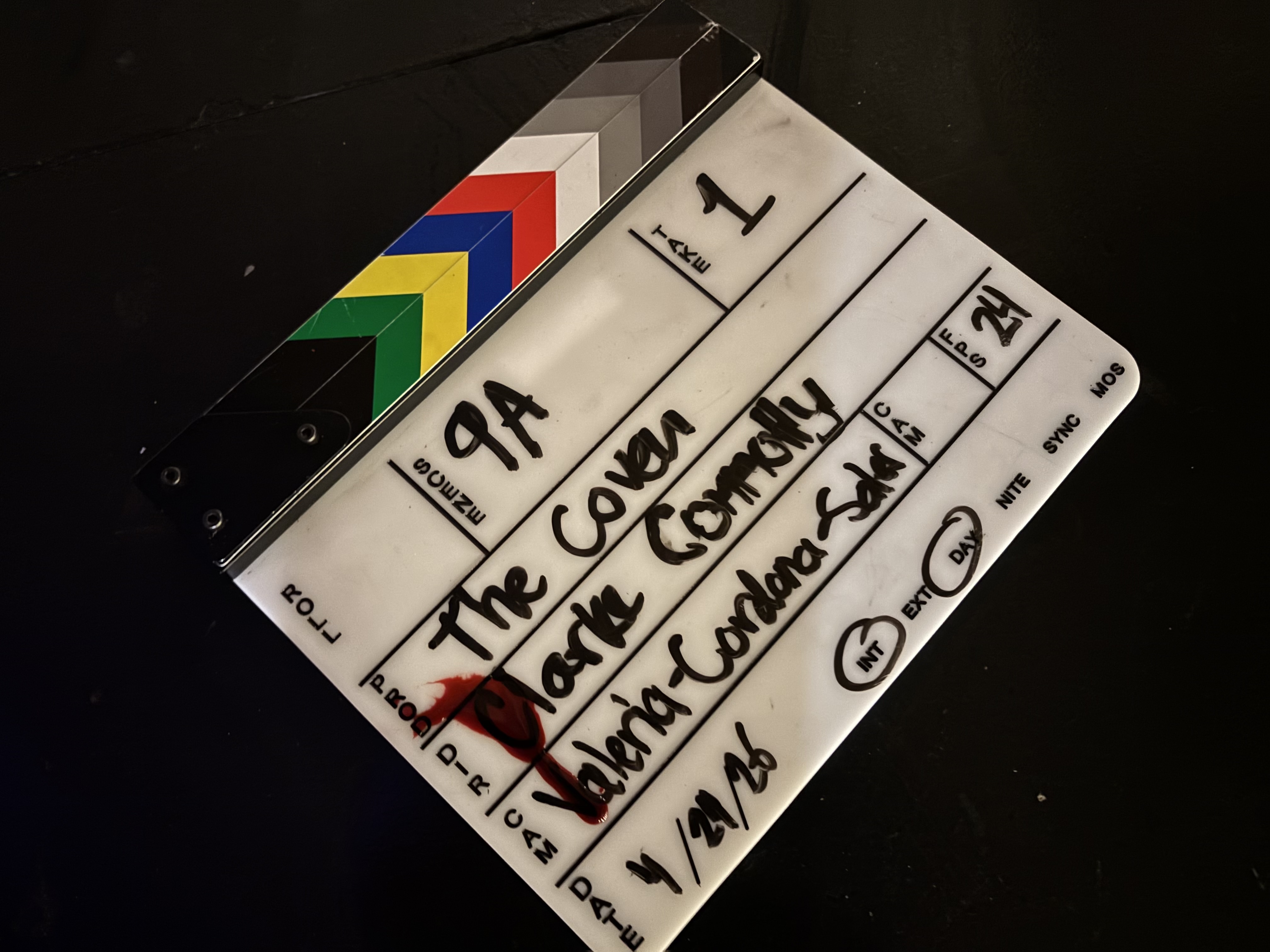
The Sophomore Film is a project that all film students look forward to in their second year. It’s a short film that the tenth grade film students at Baltimore School for the Arts (BSA) work on together.
Known as a stressful, bonding experience, it’s recognized as the first official film set these students get to work on together. Filming starts in late April, and the project concludes with the film’s premiere at the end-of-year film screening in late May.
“There’s almost a sense of magic around this [film],” said Miles Engel-Hawbecker, the Production II teacher in the Film Department.
In the beginning, all students submit an original screenplay, which is voted on by the other students and eventually chosen by the teachers.
Engel-Hawbecker said that he usually wants the script that is the most “unique and well-developed.” He tries to add a different voice to the subject, taking a different perspective than Film Department heads Thomas Ventimiglia and Bea Bufrahi.
After the script is chosen, roles are assigned to the sophomore filmmakers.
Each student applies for their top three preferred roles, such as producer, director, production design, and editor. When students receive their roles, the hallway where the results are posted is either filled with tears or smiles.
Junior Sydney Sharp, the director of the 2025 Sophomore Film explained, “I just kind of remember the air of disappointment, which inevitably is gonna happen.”
Junior Kayla Buckley, the writer of the 2025 Sophomore Film, said, “Pre-production was stressful.” It mainly falls on the producer, production design, props, makeup and hair, and wardrobe to try and gather everything together. Pre-production consists of the production schedule being made, materials being gathered, budgeting, shot lists, and location scouting.
Though, this is all just a buildup to the stress of production.
There is only a week of production for the Sophomore Film. Students have time to film during the first half of the school day and after school. The time crunch creates a lot of tension, but Clarke Connolly, the writer and director of the 2026 Sophomore Film, The Coven, said, “the stress is half the fun.”
With everyone rushing to get the last shot before wrap, Buckley noted that she noticed oftentimes the cinematographer, assistant director, and director would start to argue, not because they disliked each other, but because “they all wanted to make the film good.” She also added that it felt like they “achieved a flow state” during the production period.
When filming has ceased, and while other roles in the film are cleaning up and enjoying that just-wrapped feeling, the editor’s work has just begun. There are four editing jobs, divided up depending on how many students are available: lead editor, assistant editor, graphics and poster, and colorist.
As a result of the stressful environment, there are impacts on the class dynamics. It can create divides between people and leave some with grudges.
Sharp said it takes a lot of “emotional maturity” to remind yourself it’s not personal, especially when “it’s 8 p.m., and you’re trying to get the shot done,” and everyone is under pressure and yelling. It’s simply a part of the experience.
Some students said that it brought them closer to each other, specifically people they hadn’t worked with before. Jonathan Ford, a production assistant and editor on the 2025 film, said, “Overall I learned to trust more of my classmates film-wise.”
Engel-Hawbecker even noticed that generally, each student comes back from it the same way. Before the Sophomore Film process, he had to “tell them to be quiet in class all the time.” But after it, “Without fail, every single student kind of develops very quickly, and has a sense of responsibility.”
No matter what role or how big the responsibilities are, working on the Sophomore Film is beneficial for individual students’ skills. As Ford said, “it sheds light on how many people, skill, and materials it takes to create a decent film.”
Having the experience of being on a film set, even if it’s student-run, is crucial for film students to understand what goes on behind the scenes of a movie. It gives students a true sense of what it is like to work on a film set and with their classmates.
Beyond just experience, executing these roles gives students a major edge to their portfolios: Sharp even said that being director of the 2025 film helped her achieve the role of Film Department Representative in the Student Government Association.
The Sophomore Film experience has its ups and downs like any other project, and the real set experience and classmate bonding is truly unforgettable for film students.
Sharp, when reflecting on the overall journey, said, “this is why I’m a film student. I just love it.”
To contact this writer, email Muse Newspaper at musebsa@bsfa.org.
Featured photo by Nola Harvey and Cassidy Quaerna for The Muse.